Friday, November 5, 2010

The Adventures of Tom Sawyer - Mark Twain

Quote of the book:
“Within two minutes, or even less, he had forgotten all his troubles. Not because his troubles were on whit less heavy and bitter to him than a man’s are to a man, but because a new and powerful interest bore them down and drove them out of his mind for the time—just as men’s misfortunes are forgotten in the excitement of new enterprises” (14).

This excerpt introduces us to the character Tom Sawyer, as any young child, who is carefree, and holds a small attention span, that allows grudges to be lifted in the shortest of times. This also sets the stage for the various events and adventures that unfold in this book. An example of this is Tom Sawyer and his love interest Becky Thatcher. When he first starts to woo her, he tells her about kissing and introduces her to the whirlwind world of romance. He, at first, fails to mention his past love, as it is a thing of the past and things of the past are usually forgotten by a child like Tom Sawyer. Even after breaking Becky Thatcher’s heart, he is upset, until he gets involved in the next game that he and Huck Finn will be playing. Another example is the effect he has on his aunt. The antics that Tom Sawyer always gets involved in worries his Aunt Polly, to the point of her believing that he has died. When Tom realizes the harm that he has done to his aunt, he is upset, and feels guilty about his actions, until another event comes to take his mind off of things.

Connection:
Something that I instantly thought of upon seeing this character was none other than the fantastical character Peter Pan. In the J.M. Barrie play, Peter Pan is reputed as being a mischievous boy, and somewhat of a manipulative character as well. He uses his smarts to convince Wendy to do certain actions she normally would not, such as stay in Neverland with him. Our protagonist in The Adventures of Tom Sawyer, is also the same way. When he does not want to go to school on that gloomy Monday, he studies his body in order to find an illness that he can successfully enact. He goes through an overbearing amount of work to ensure that he gets whatever it is that he would like. The other famous example is when Tom Sawyer takes advantage of his own friends in order to go out and play. The classic scene begins with Tom Sawyer painting this fence for his aunt as a form of punishment. As he sees his friend, he begins to twist the task, to make it look like something the others would envy him for. In the end, he ends up manipulating his friends in order to get them to paint the fence for him, while he goes off to play.

Another comparison is not solely to the character but the premise of the story itself. There are dark elements in Tom Sawyer, as in Peter Pan. The central theme that can be found in Peter Pan is the oncoming age of adulthood, which Peter attempts to avoid in all circumstances. He takes children away in order to keep them from becoming adults, though he often finds himself returning children, and letting them grow up. In the way that this play is told, it creates the sentimental value of being a child, and we see this in moments where the author asks the audience to clap if they believe in fairies, something that adults would handle differently in their mature mindset. Meanwhile, Tom Sawyer’s story is about the life of a child. Take for example the various events that occur. With Injun Joe committing these crimes, the whole town is in a panic, knowing that there is a dangerous criminal on the loose. Of course this concerns our young hero and his friend, although their main concern is easily shifted to Injun Joe’s buried treasure and the ghost possibly haunting the two boys. Earlier on, when Tom and Huck witness the crime, they are instantly terrified and contemplate whether to tell anyone, with their problem being that of snitching, a common childhood worry that many of us have heard of. The story is also told so that we see the mindset of a child, with their innocent games that they play throughout the typical day.

Visual Representation:
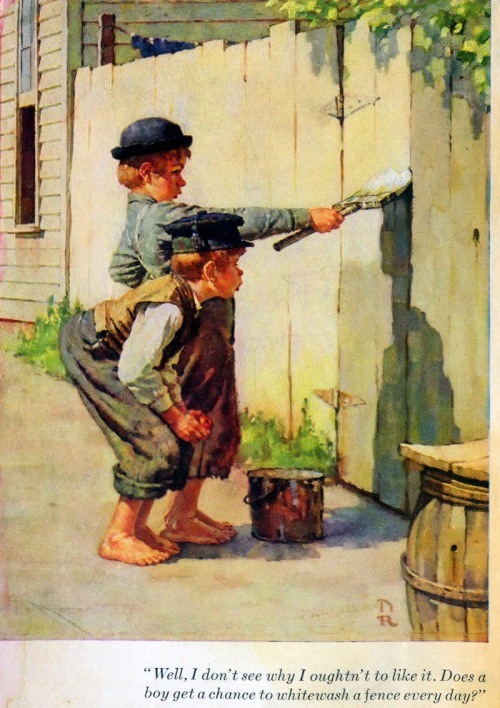

The illustrations provided by Norman Rockwell in certain editions of The Adventures of Tom Sawyer actually provide a relatively accurate setting of the Deep South. His paintings are also accurate in capturing the mood of this book. It can be one that could be further analyzed, and of course, this is a book that can be looked at upon a much deeper basis. However, on the outside, it is a pleasant and enjoyable read, with commonly lighthearted moods and a beautiful and bright setting. The vibrant colors go only further to show the light tone of this book and the joy that the boys find in their adventures. The characters' emotions are also well displayed in this and show a typical childlike behavior, full of natural curiosity. Tom, painting the fence, has a mock determined look on his face as he paints, also a nonchalant expression at the same time to express his feelings on painting this fence. Meanwhile, his friend, crouched over with his lips pursed in interest shows a curious expression, even one that is in wonder as he sees this fun activity being done. Going even further, it can be noted that the image selected is from the scene in which Tom Sawyer tricks his friends into painting his fence, which is a very important scene from the book, especially when it comes to the analysis of the character Tom Sawyer, the central character of the book.

Questions:
1. What would be a fitting career for the young Tom Sawyer?
2. Does Tom mature throughout the course of the book, and in what ways?
3. Consider the setting of the book: Is the setting fundamental to the plot or any morals that might be portrayed in this book, or not? Why?
4. Based off of Tom’s experience with the church and Sunday school, what might one conclude on Mark Twain’s view on religion?
5. What sort of commentary is Mark Twain providing regarding the benefits and disadvantages of childhood?

Reflection:
The interesting aspect of reading this book was the language used by Mark Twain in order to create an authentic experience for the reader. I felt fully immersed in the world of Tom Sawyer, where newfangled technology felt like an extraordinary wonder and impressed me, despite this technology being outdated to someone like me. However, at the same time, this made the text harder to understand, seeing as Twain frequently cut out letters and used apostrophes, and intentionally used incorrect verbs to make thins more believable. The book was still regardless an interesting and beneficial read. The short chapters were divided as to split up the many adventures that Tom and his friends embarked on. No matter how mundane these appeared to an average reader, or how uneventful they were, the characters made the tasks all very highly interesting. Considering the insightful perspective we had, the story was told in a fashion that allowed the reader to fully get into the mind of Tom. As we had described in class, magical realism is seeing things through the perspective of a child. When Tom and his friends pretend to be pirates, they do so in a naïve manner. We all know that pirates, regardless of the glamorous reputation they had, were actually ruthless when it came to violence. People like Tom Sawyer however, have yet to be exposed to that, and therefore, pretend to be them, without realizing the evils behind their activities.
This perspective also contributes to the main plot. This plot takes rather long to set up, it is really only introduced after the second half of the book, however, is blended into the rest of the story very well. Since the kids witness a heinous crime committed, they begin to fear for their lives, and end up swearing to "keep mum" about what they witnessed. While fearing that they are going to be caught by Injun Joe, after having exposed what Injun Joe had done, they also quickly move on to their next adventure, endangering themselves even more. What is great is to see a book in which we can all revisit the reckless acts committed as a child, and realize we were not alone, nor were we completely wrong in doing any of these actions.

Thursday, October 7, 2010

Mr. Clemens and Mark Twain - Justin Kaplan

Quote of the book:
"'Mark Twain' is comparably responsive to the demands of his readers. He can be instructive and 'serious,' pious, rhetorical, generous, with straight guidebook information...Through Mark Twain Samuel Clemens begins to rediscover his youth and translate it into literature" (page 72).

This excerpt is from the explanation of the origins of Mark Twain. To summarize, Mark Twain was a character, and a persona that Clemens embodied. According to the excerpt, Mark Twain could be any kind of person. His writing style could change, what he chooses to write about could also change, seeing as the amount of published works grew throughout his life, along with the subjects, genres, and other aspects that made his books all rather diverse. I believe this is important to the biography as it shows what it is that really embodies Samuel Clemens. The fact that he has this alter ego who publishes Clemens' work is pivotal to who he is. As for the latter, it can be said that Tom Sawyer incorporates a significant matter of childhood memories that belong to Clemens. An example of this would be Tom visiting the graveyard. Although not exactly the same, this part was an allusion to a memory of Clemen's in which he found a dead body. As mentioned by the quote above, Mark Twain helped Samuel Clemens extract aspects of his childhood and mention them in his writing. Essentially, these are the foundations for some of Clemen's most influential works.

Connection:
A comparison that I remarked in the book actually had to do with what we are currently studying in class. We are currently in the process of reading The Metamorphosis by Franz Kafka. Prior to reading this, we watched a documentary, learning about Kafka's family life. I came to the conclusion that many elements that appeared in Kafka's writing were elements that involved his real life and personal issues, a strong example being the abuse that Kafka was subject to as a child making an appearance in The Metamorphosis. Kafka makes frequent allusions to his personal life in his writings, (i.e. the slight variation of the name Kafka to create Samsa). In Clemen's case, his childhood sweetheart, Laura Hawkins, makes an appearance in his writings, having been developed into a character. However, he goes further to develop her character and create a future for her as well. She also serves as the inspiration of Becky in the popular book Tom Sawyer.

Although it is unknown to me whether Mark Twain was a prodigal writer as a child, his life is similar to Mozart's in a sense. They both went through a rather vicious cycle. Mozart, the young prodigy, got his parents out of debt, and earned money touring Europe, making it from poverty into becoming an internationally renowned figure. When Mozart had finally liberated himself from his father, he lived a rather lavish lifestyle, which soon made him run into problems when it came to supporting the fundamentals. Mark Twain had made a fortune off of The Innocents Abroad. He spent it on a variety of objects and commodities, yet had a difficulty supporting his family, and was often reprimanded by his family on that.

Also, Mark Twain's writing of The Prince and the Pauper reminds me of the many fairy tales that we all know at the moment. It is a fact that I often forget that The Prince and the Pauper was not written during the time of fairy tales, but rather years later. However, similarly to the tales written by the Grimm Brothers, it has an element to it that allows it to be perceived as a fantasy story that may have been written by the people of the time period in which the piece takes place.

Visual Representation:

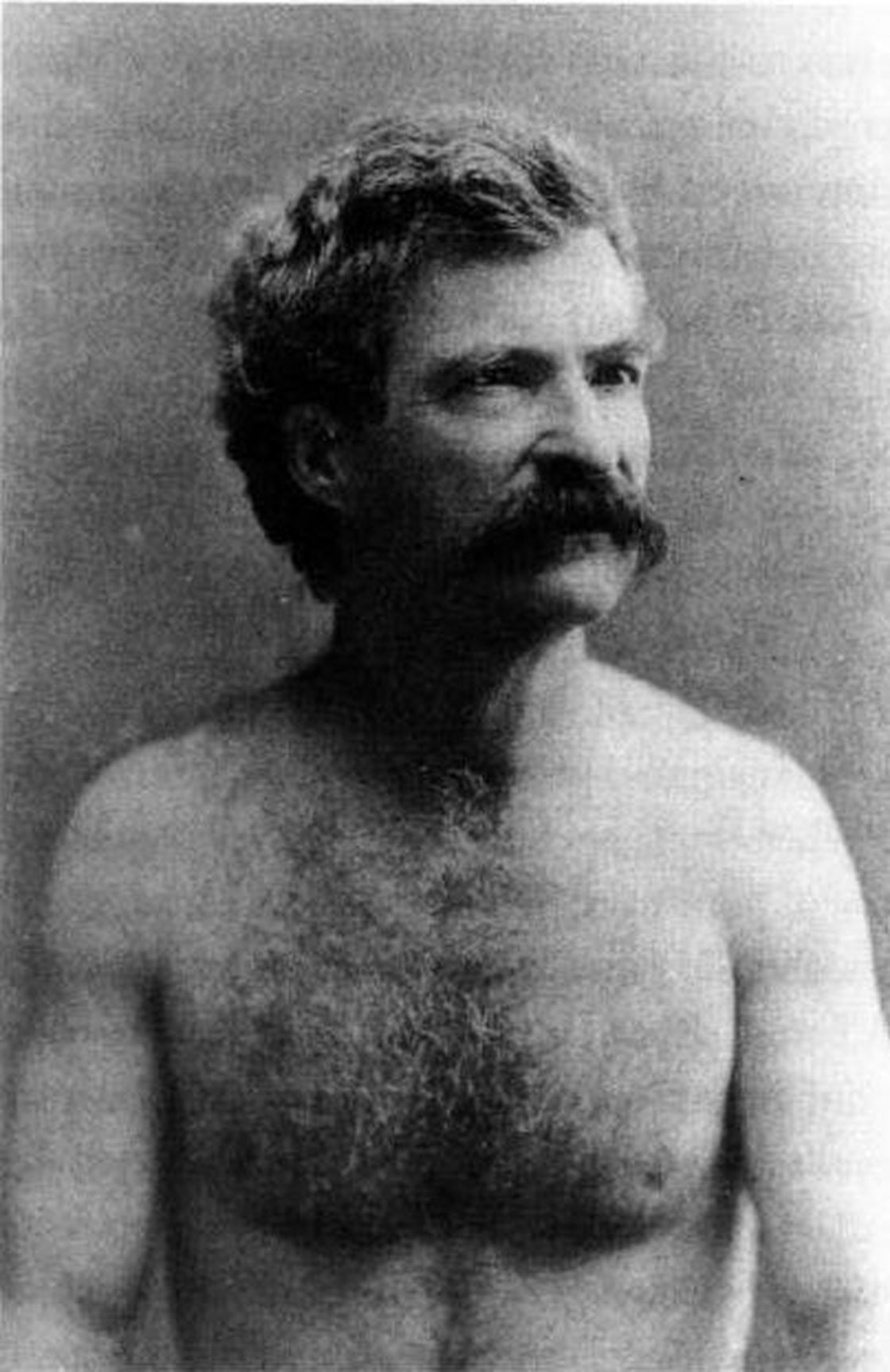
Since this is a biography, I consider the central image of his biography a portrait of him. However, not any portrait of him would do. That would be taking the easy way out. Instead, I came across this, which was also one of the images included in his biography, and I was instantly struck by the premise of this picture. Here was a Mark Twain exposing himself, doing something that was completely against the values of society. In person, he was someone who acted against society's ideals. He was known for an alcoholic behavior and for a boisterous attitude alongside that. Many referred to him as a drunkard, and there was always something to be said about his behavior. He recalls being a child until he meets Olivia Langdon. I found that this picture really showed his erratic character, alongside his role as a humorist in American society.
Questions:
  1. Were there any people or writings that may have had an influence on Mark Twain?
  2. What do we know about Clemen's parents that could allow us to draw conclusions on how they affected Mark Twain?
  3. Why is the setting of the Deep South so dear to Mark Twain and what effect does it have on his works?
  4. What is religion's value to Mark Twain versus religion's value to Samuel Clemens?
  5. How did the deaths of Mark Twains' children affect him, and could that effect be seen in his work?

Reflection:
I enjoyed the book, however, I felt that it was almost too flourished to be a proper biography. It was more focused on Samuel Clemen's behavior, and less on what he had actually accomplished. Personally, I had never really had much information on Mark Twain, only the books that he was attributed to, long with the fact that he was born and died on Halley's Comet. As a result of this, I learned about Mark Twain's character, and Mark Twain versus Samuel Clemens. I definitely liked this unique and intimate view of a fascinating and esoteric character. However, the downside of this was that I did not learn as much about what he actually contributed, or what else he released.

Another issue that I had with this book was that there was no focus on his childhood. If this book chose to be a psychological study of Samuel Clemens, then the fact that this is lacking in his childhood makes it almost not as effective as the book could be. I believe that the childhood is almost essential to a psychological analysis of a figure. Also, the events start at a very late age of his life, where he is about prepared to adopt the name Mark Twain, and so on. This also was very bothersome, and even Kaplan's justification for the omission of these did not sway me.

The writing style, although lengthy, was interesting and made it a much more interesting read than having to hear fact after fact after fact. Instead, the decorated descriptions made the read much more compelling.